> For the complete documentation index, see [llms.txt](https://help.bioinsight.illumina.com/llms.txt). Markdown versions of documentation pages are available by appending `.md` to page URLs; this page is available as [Markdown](https://help.bioinsight.illumina.com/partek/partek-flow/user-manual/task-menu/quantification/salmon.md).
# Salmon
* [Running Salmon](#running-salmon)
* [References](#references)
Salmon1 is a method for quantifying transcript abundance from raw read sequence fastq files, it will generate transcript level count matrix as output.
## Running Salmon
*Salmon* will run on any FASTQ file input.
* Click the data node containing your FASTQ files
* Click the **Quantification** section in the toolbox
* Click **Salmon**
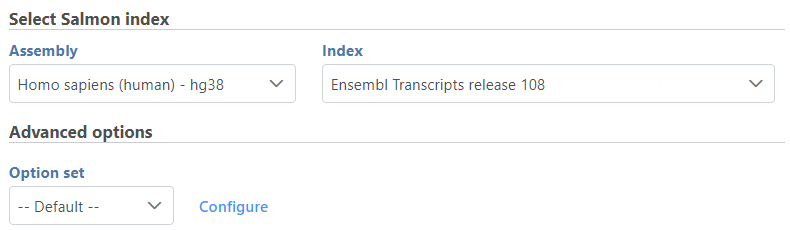
* Choose *Assembly* and *Aligner index* on gene annotation model (Figure 1)
Salmon index can't be built on reference assembly, you need to provide transcript annotation file beforehand, the index will be built on transcript annotation model. For more information about adding aligner index based on annotation model, see this [chapter](/partek/partek-flow/user-manual/settings/components/library-file-management/adding-aligner-indexes-based-on-an-annotation-model.md) in library file management.
The task generates two data nodes: Transcript counts node contains NumReads which is the estimate of number of reads mapping to each transcript; the best estimate is often not integer. Gene counts node contains the sum of all the reads from the corresponding transcripts from each gene.
Note: If you want to perform differential analysis, you need to add offset to deal with 0 values.
## References
1. Rob Patro, Geet Duggal, Michael Love, Rafeal A Irizarry, Carl Kingsford. *Salmon*: fast and bias-aware quantification of transcript expression using dual-phase inference. Published online 2017 Mar 6. doi:[10.1038/nmeth.4197](https://dx.doi.org/10.1038%2Fnmeth.4197)
## Additional Assistance
If you need additional assistance, please visit [our support page](http://www.partek.com/support) to submit a help ticket or find phone numbers for regional support.
---
# Agent Instructions
This documentation is published with GitBook. GitBook is the documentation platform designed so that both humans and AI agents can read, navigate, and reason over technical content effectively. Learn more at gitbook.com.
## Querying This Documentation
If you need additional information that is not directly available in this page, you can query the documentation by asking a question.
Perform an HTTP GET request on the following URL with the `ask` and `goal` query parameters:
```
GET https://help.bioinsight.illumina.com/partek/partek-flow/user-manual/task-menu/quantification/salmon.md?ask=&goal=
```
`ask` is the immediate question: it should be specific, self-contained, and written in natural language.
`goal` is what the user is ultimately trying to achieve, the reason they need the answer. Sharing it helps GitBook give you a better, more relevant answer. A goal is most helpful when it describes the outcome the user wants rather than restating the question. For example, with `ask=how do I create an API token`, a goal like `automate deployments from our CI pipeline` lets GitBook tailor the answer to that use case.
The response will contain a direct answer to the question and relevant excerpts and sources from the documentation.
Use this mechanism when the answer is not explicitly present in the current page, you need clarification or additional context, or you want to retrieve related documentation sections.