> For the complete documentation index, see [llms.txt](https://help.bioinsight.illumina.com/llms.txt). Markdown versions of documentation pages are available by appending `.md` to page URLs; this page is available as [Markdown](https://help.bioinsight.illumina.com/partek/partek-flow/user-manual/task-menu/normalization-and-scaling/tf-idf-normalization.md).

# TF-IDF normalization

Latent semantic indexing (LSI) was first introduced for the analysis of scATAC-seq data by [Cusanovich et al. 2018](https://www.nature.com/articles/nature25981)\[1]. LSI combines steps of frequency-inverse document frequency (TF-IDF) normalization followed by singular value decomposition (SVD). Partek Flow wrapped Signac's TF-IDF normalization for single cell ATAC-seq dataset. It is a two-step normalization procedure that both normalizes across cells to correct for differences in cellular sequencing depth, and across peaks to give higher values to more rare peaks\[2].

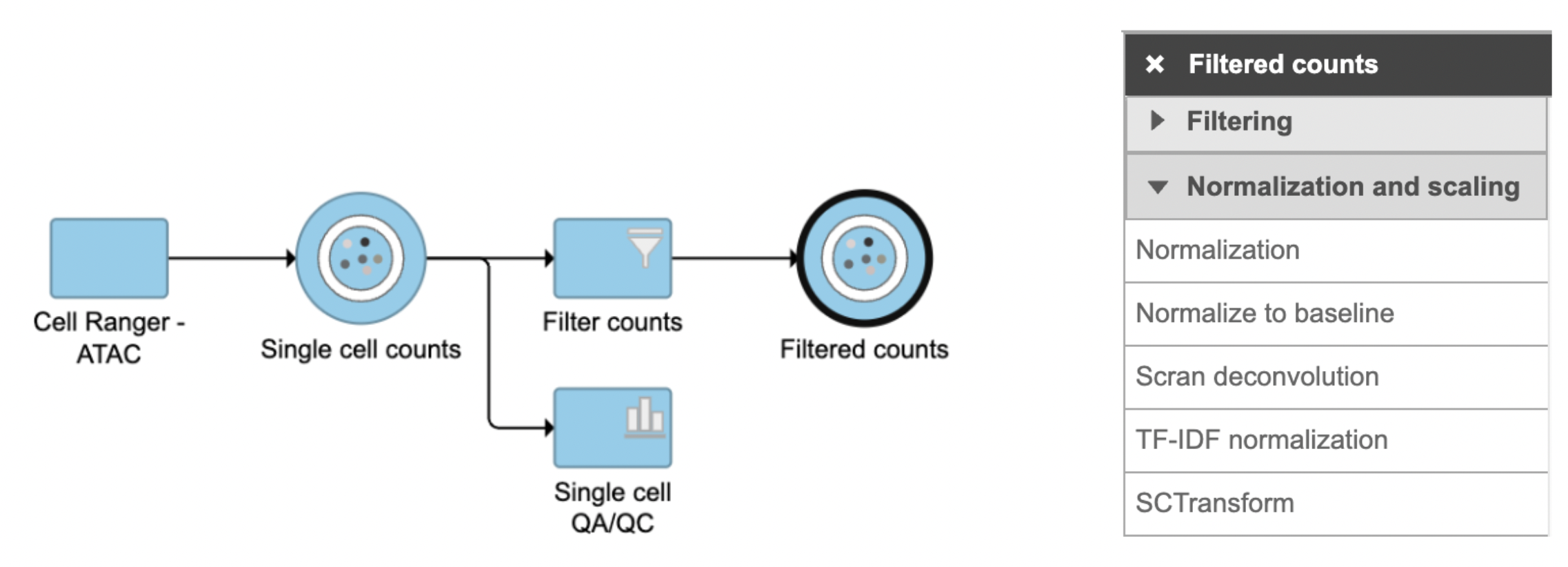
**TF-IDF normalization** in Flow can be invoked in *Normalization and scaling* section by clicking any single cell counts data node (Figure 1).
<div align="left"><img src="https://1384254481-files.gitbook.io/~/files/v0/b/gitbook-x-prod.appspot.com/o/spaces%2FJVEESmJAPppJ3ijFq5aR%2Fuploads%2Fgit-blob-7c05b0374e278c7ae7b452ee001d7dcc495dc832%2FFigure%201.png?alt=media" alt="Figure 1. TF-IDF normalization task in Normalization and scaling section in Flow."></div>

To run **TF-IDF normalization**,

* Click a **single cell counts** data node
* Click the **Normalization and scaling** section in the toolbox
* Click **TF-IDF normalization**

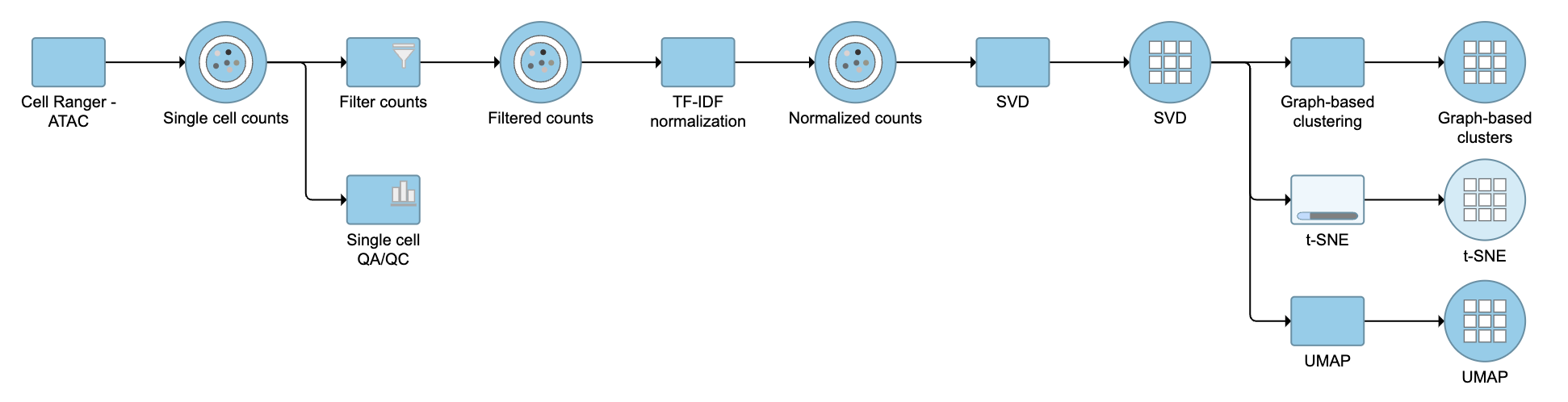
The output of **TF-IDF normalization** is a new data node that has been normalized by log(*TF x IDF*). We can then use this new normalized matrix for downstream analysis and visualization (Figure 2).

<div align="left"><img src="https://1384254481-files.gitbook.io/~/files/v0/b/gitbook-x-prod.appspot.com/o/spaces%2FJVEESmJAPppJ3ijFq5aR%2Fuploads%2Fgit-blob-926505535ba0b04dbe322edd2a960b11bb2e3155%2FFigure%202%20(1).png?alt=media" alt="Figure 2. Example workflows to demonstrate downstream analysis and visualization of TF-IDF normalization output."></div>

## References

1. Cusanovich, D., Reddington, J., Garfield, D. *et al.* The *cis*-regulatory dynamics of embryonic development at single-cell resolution. *Nature* **555,** 538–542 (2018). <https://doi.org/10.1038/nature25981>
2. <https://satijalab.org/signac/index.html>

## Additional Assistance

If you need additional assistance, please visit [our support page](http://www.partek.com/support) to submit a help ticket or find phone numbers for regional support.


---

# Agent Instructions
This documentation is published with GitBook. GitBook is the documentation platform designed so that both humans and AI agents can read, navigate, and reason over technical content effectively. Learn more at gitbook.com.

## Querying This Documentation
If you need additional information that is not directly available in this page, you can query the documentation by asking a question.

Perform an HTTP GET request on the following URL with the `ask` and `goal` query parameters:

```
GET https://help.bioinsight.illumina.com/partek/partek-flow/user-manual/task-menu/normalization-and-scaling/tf-idf-normalization.md?ask=<question>&goal=<user_goal>
```

`ask` is the immediate question: it should be specific, self-contained, and written in natural language.
`goal` is what the user is ultimately trying to achieve, the reason they need the answer. Sharing it helps GitBook give you a better, more relevant answer. A goal is most helpful when it describes the outcome the user wants rather than restating the question. For example, with `ask=how do I create an API token`, a goal like `automate deployments from our CI pipeline` lets GitBook tailor the answer to that use case.

The response will contain a direct answer to the question and relevant excerpts and sources from the documentation.

Use this mechanism when the answer is not explicitly present in the current page, you need clarification or additional context, or you want to retrieve related documentation sections.
