> For the complete documentation index, see [llms.txt](https://help.bioinsight.illumina.com/llms.txt). Markdown versions of documentation pages are available by appending `.md` to page URLs; this page is available as [Markdown](https://help.bioinsight.illumina.com/illumina-trupath-genome/run-analysis-setup/cloud-analysis-settings.md).
# Cloud Analysis Settings
Overview of DRAGEN Secondary Analysis and Cloud Analysis Settings
### Illumina TruPath Genome DRAGEN Germline Workflow
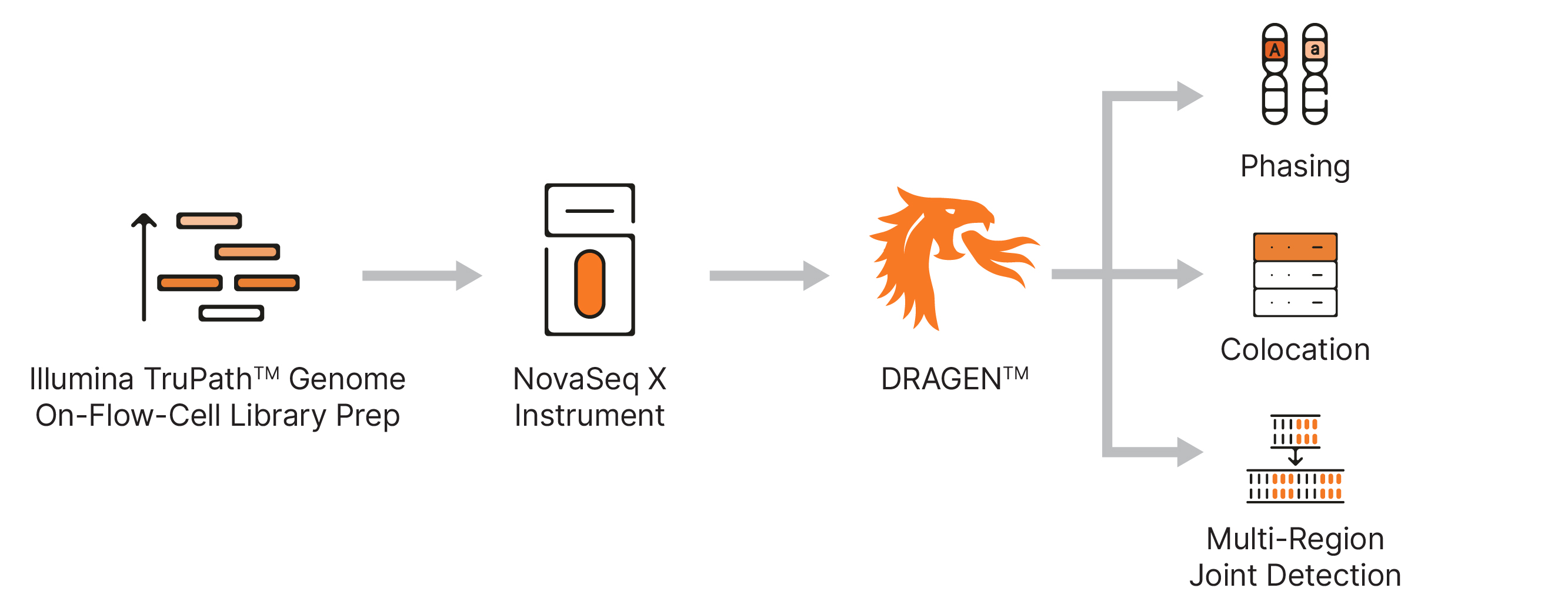
When proximity mode is enabled, the DRAGEN Germline pipeline supports secondary analysis of TruPath sequencing data, leveraging proximity data to perform the following:
* Provide phased small variant calls and ultra-long phasing blocks, resolving haplotypes
* Resolve mapping ambiguities in challenging regions of the genome, including regions of high homology and segmental duplications
* Provide enhanced structural variant insights using colocation detection
#### Basespace Run Planning / Autolaunch Settings
The DRAGEN Germline pipeline application accessed via BaseSpace Sequence Hub (BSSH) Autolaunch [described in this section here](#illumina-trupath-genome-dragen-germline-workflow) performs the following settings for each variant, including the following per each category:
* **None:** Performs Map/Align by enabling proximity mode.
* **Small Variant Callers:** Enables associated proximity mode callers, including:
* Targeted Callers (enables a subset of targeted callers)
* **All Variant Callers:** Enables associated proximity mode callers listed in Small Variant Callers category, and:
* Multi-Region Joint Detection (MRJD) calling on default genes.
* Copy Number Variant (CNV) calling
* Structural Variant Calling
* Short Tandem Repeats (STR) calling
#### Basespace Application and Platform Core Pipeline Settings
The DRAGEN Germline pipeline may be accessed via BaseSpace Appllication or in Platform Core. Both perform the following settings for each variant, including the following per each category:
* Performs Map/Align by enabling proximity mode.
* Small Variant Calling, with option to enable personalization
* Copy Number Variant (CNV) Calling, including CNV related settings
* Structural Variant Calling and related settings
* Short Tandem Repeats (STR) Calling with phasing
* Targeted Callers, including `lpa`, `hba`, and `smn`
---
# Agent Instructions
This documentation is published with GitBook. GitBook is the documentation platform designed so that both humans and AI agents can read, navigate, and reason over technical content effectively. Learn more at gitbook.com.
## Querying This Documentation
If you need additional information that is not directly available in this page, you can query the documentation by asking a question.
Perform an HTTP GET request on the following URL with the `ask` and `goal` query parameters:
```
GET https://help.bioinsight.illumina.com/illumina-trupath-genome/run-analysis-setup/cloud-analysis-settings.md?ask=&goal=
```
`ask` is the immediate question: it should be specific, self-contained, and written in natural language.
`goal` is what the user is ultimately trying to achieve, the reason they need the answer. Sharing it helps GitBook give you a better, more relevant answer. A goal is most helpful when it describes the outcome the user wants rather than restating the question. For example, with `ask=how do I create an API token`, a goal like `automate deployments from our CI pipeline` lets GitBook tailor the answer to that use case.
The response will contain a direct answer to the question and relevant excerpts and sources from the documentation.
Use this mechanism when the answer is not explicitly present in the current page, you need clarification or additional context, or you want to retrieve related documentation sections.