> For the complete documentation index, see [llms.txt](https://help.bioinsight.illumina.com/llms.txt). Markdown versions of documentation pages are available by appending `.md` to page URLs; this page is available as [Markdown](https://help.bioinsight.illumina.com/emedgene/emedgene-curate-manual/curate_variant_annotations_in_the_case/curate-variant-annotations.md). Agents can also search and read this documentation through its [MCP server](https://help.bioinsight.illumina.com/~gitbook/mcp).

# Curate variant annotations

## Pathogenicity

Variant pathogenicity stored in **Curate** is displayed:

* In the **Known Variants** column of the **Variant table** (Fig. 1)
* On the **Variant page**:
  * In the **Summary tab** (Fig. 2)
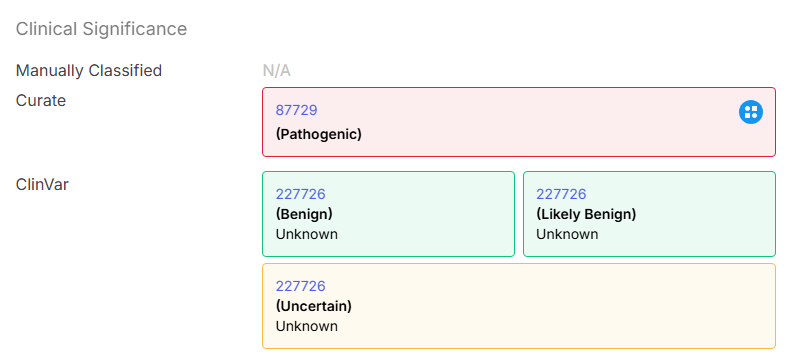
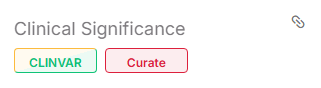
  * In the **Clinical Significance tab** (Fig. 3)
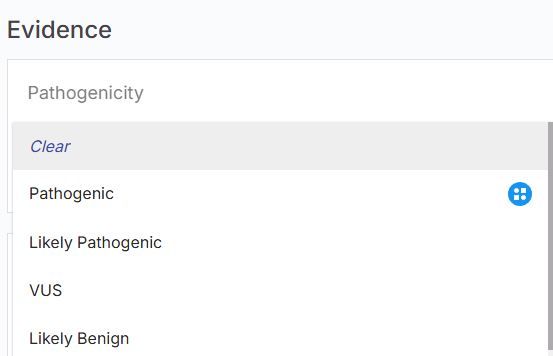
  * In the **Evidence tab** (Fig. 4)

<div data-with-frame="true"><img src="https://1131024994-files.gitbook.io/~/files/v0/b/gitbook-x-prod.appspot.com/o/spaces%2FGCW0DnLlE7QjoZPNmKIi%2Fuploads%2Fgit-blob-779acb6883eab530aa9169433da25c0629f026a8%2Fvt.png?alt=media" alt="Figure 1. Curate pathogenicity badge in the Known Variants column of the Variant table."></div>

<div align="left" data-with-frame="true"><figure><img src="https://1131024994-files.gitbook.io/~/files/v0/b/gitbook-x-prod.appspot.com/o/spaces%2FGCW0DnLlE7QjoZPNmKIi%2Fuploads%2Fgit-blob-ce427ef5abcdac906fcfff9a213d02a2089c5651%2FNCS.png?alt=media" alt="Fig. 2. Curate pathogenicity badge in the Summary tab of the Variant page."><figcaption><p>Figure 2. <strong>Curate</strong> pathogenicity badge in the <strong>Summary tab</strong> of the <strong>Variant page</strong>.</p></figcaption></figure></div>

<div align="left" data-with-frame="true"><figure><img src="https://1131024994-files.gitbook.io/~/files/v0/b/gitbook-x-prod.appspot.com/o/spaces%2FGCW0DnLlE7QjoZPNmKIi%2Fuploads%2Fgit-blob-bbf87f7e0f827c242774602e1aa3c26121621597%2Funcertain.png?alt=media" alt="Fig. 3. Curate symbol indicating curated pathogenicity in the Clinical Significance tab of the Variant page." width="563"><figcaption><p>Figure 3. <strong>Curate</strong> symbol indicating curated pathogenicity in the <strong>Clinical Significance tab</strong> of the <strong>Variant page</strong>.</p></figcaption></figure></div>

<div align="left" data-with-frame="true"><figure><img src="https://1131024994-files.gitbook.io/~/files/v0/b/gitbook-x-prod.appspot.com/o/spaces%2FGCW0DnLlE7QjoZPNmKIi%2Fuploads%2Fgit-blob-ee15af619991ef0772df37f051656c10651076ac%2FEVI.png?alt=media" alt="Fig. 4. Curate symbol indicating curated pathogenicity in the Evidence tab of the Variant page." width="415"><figcaption><p>Figure 4. <strong>Curate</strong> symbol indicating curated pathogenicity in the <strong>Evidence tab</strong> of the <strong>Variant page</strong>.</p></figcaption></figure></div>

## ACMG classification

ACMG classification stored in **Curate** is automatically applied to small variants. This includes:

* Tag status
* Tag strength
* Answers to tag questions
* Tag notes

ACMG classification from **Curate** appears on the **Variant page**:

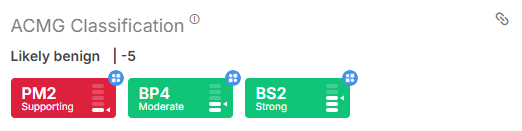
* In the **Summary tab** (Fig. 5)
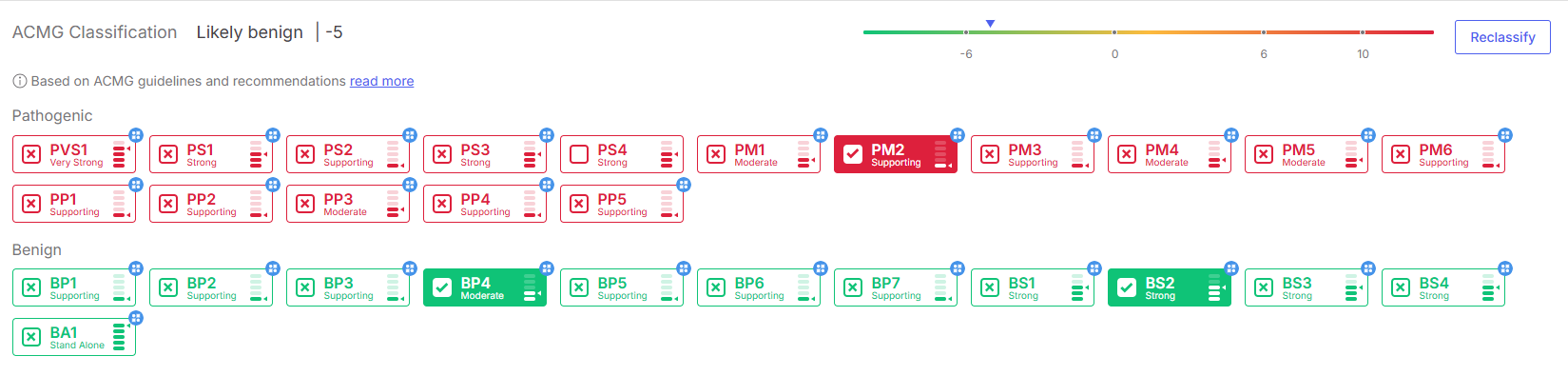
* In the **Evidence tab** (Fig. 6)

<div align="left" data-with-frame="true"><figure><img src="https://1131024994-files.gitbook.io/~/files/v0/b/gitbook-x-prod.appspot.com/o/spaces%2FGCW0DnLlE7QjoZPNmKIi%2Fuploads%2Fgit-blob-3b34ae9b2e1b8acc3baf131f7072c9b9fdc030b8%2Facmg%20classification%20summary.png?alt=media" alt="Fig. 5. Curate icon for ACMG classification in the Summary tab."><figcaption><p>Figure 5. <strong>Curate</strong> symbols indicating curated ACMG tags in the <strong>Summary tab</strong> of the <strong>Variant page</strong>.</p></figcaption></figure></div>

<div align="left" data-with-frame="true"><figure><img src="https://1131024994-files.gitbook.io/~/files/v0/b/gitbook-x-prod.appspot.com/o/spaces%2FGCW0DnLlE7QjoZPNmKIi%2Fuploads%2Fgit-blob-21b5e628e86f8af97dcebc2d6da82bb9f2cca5cc%2Facmg%20classification%20evidence.png?alt=media" alt="Fig. 6. Curate icon for ACMG classification in the Evidence tab."><figcaption><p>Figure 6. <strong>Curate</strong> symbols indicating curated ACMG criteria in the <strong>Evidence tab</strong> of the <strong>Variant page</strong>.</p></figcaption></figure></div>

## Variant & gene interpretation and notes

You can import curated variant interpretation into **Variant interpretation card**. See [**Import Curate variant interpretation to the case**](https://help.bioinsight.illumina.com/emedgene/emedgene-analyze-manual/variant_page/importing-curate-variant-and-gene-data/import_curate_variant_annotations_to_the_case_-300+.md).

In V100.41+, you can also [import Curate Gene interpretation](https://help.bioinsight.illumina.com/emedgene/emedgene-analyze-manual/variant_page/importing-curate-variant-and-gene-data/import_curate_gene_annotations_to_the_case_-300+.md), as well as [Variant and Gene Interpretation Notes](https://help.bioinsight.illumina.com/emedgene/emedgene-analyze-manual/variant_page/importing-curate-variant-and-gene-data/import_variant_gene_notes.md).

## Visualization tracks

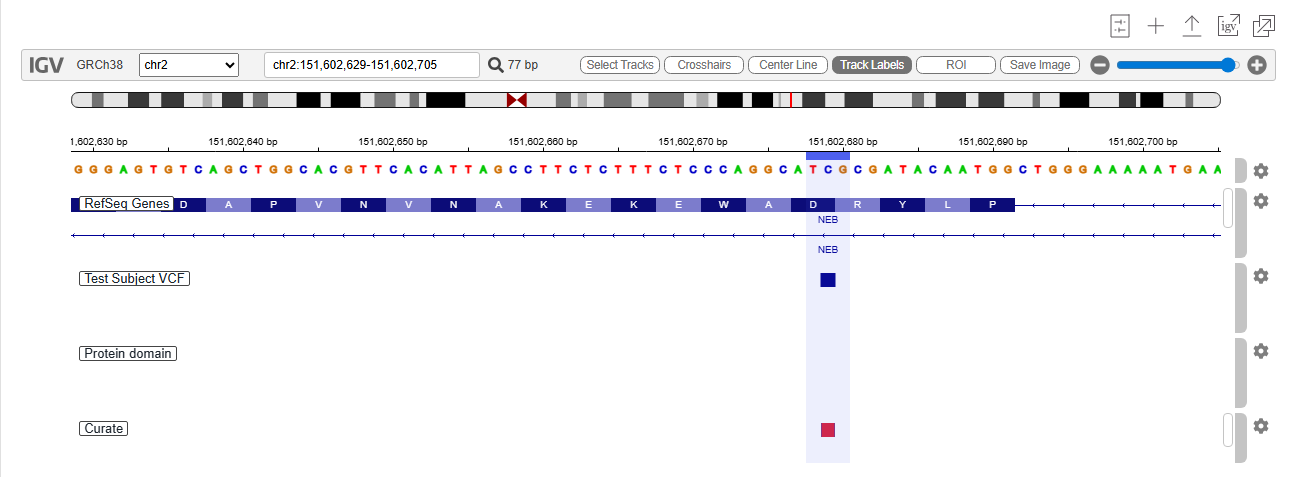
When enabled, **Curate** and **CurateSV** [visualisation tracks](https://help.bioinsight.illumina.com/emedgene/emedgene-analyze-manual/variant-visualization/variant-visualization-tool/visualization-tracks/curated-data-tracks.md) show **Curate** variants alongside alignment data in the **Visualization tab** (Fig. 7).

<div align="left" data-with-frame="true"><figure><img src="https://1131024994-files.gitbook.io/~/files/v0/b/gitbook-x-prod.appspot.com/o/spaces%2FGCW0DnLlE7QjoZPNmKIi%2Fuploads%2Fgit-blob-f3a7716f6bf170e780056bc6e2e72aa12a29e4d0%2FIGV.png?alt=media" alt="Fig. 7. Curate visualisation track in the Visualization tab of the Variant page."><figcaption><p>Figure 7. <strong>Curate</strong> visualisation track in the <strong>Visualization tab</strong> of the <strong>Variant page</strong>.</p></figcaption></figure></div>


---

# Agent Instructions
This documentation is published with GitBook. GitBook is the documentation platform designed so that both humans and AI agents can read, navigate, and reason over technical content effectively. Learn more at gitbook.com.

## Querying This Documentation
If you need additional information that is not directly available in this page, you can query the documentation by asking a question.

Perform an HTTP GET request on the following URL with the `ask` and `goal` query parameters:

```
GET https://help.bioinsight.illumina.com/emedgene/emedgene-curate-manual/curate_variant_annotations_in_the_case/curate-variant-annotations.md?ask=<question>&goal=<user_goal>
```

`ask` is the immediate question: it should be specific, self-contained, and written in natural language.
`goal` is what the user is ultimately trying to achieve, the reason they need the answer. Sharing it helps GitBook give you a better, more relevant answer. A goal is most helpful when it describes the outcome the user wants rather than restating the question. For example, with `ask=how do I create an API token`, a goal like `automate deployments from our CI pipeline` lets GitBook tailor the answer to that use case.

The response will contain a direct answer to the question and relevant excerpts and sources from the documentation.

Use this mechanism when the answer is not explicitly present in the current page, you need clarification or additional context, or you want to retrieve related documentation sections.